Worldwide Sneakerography: Russia Reprise
Depending on how long you’ve been following me, you might have seen something similar to this one a few years back…the original (with pictures) can be found here.
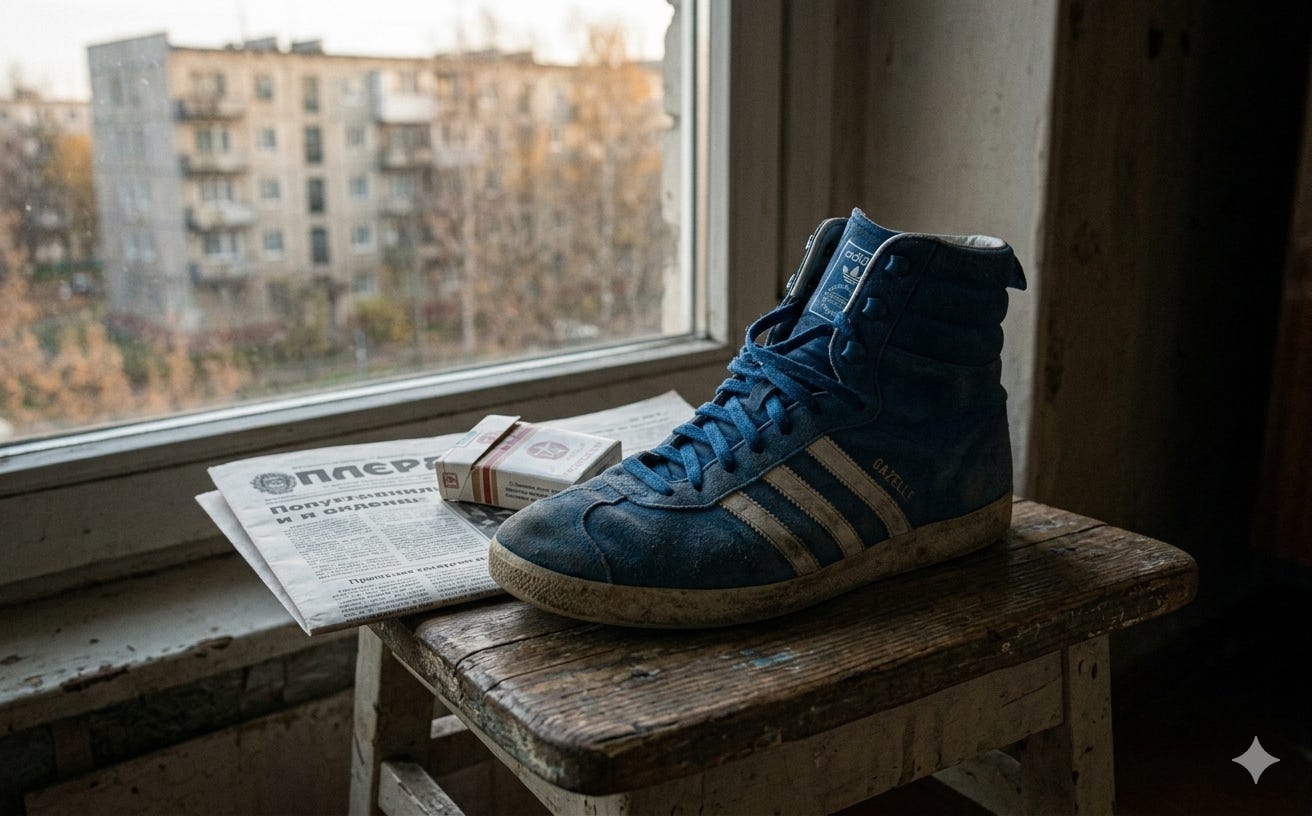
“Whoever wears Adidas, any woman will give it to him.”
For a long time, I’ve looked at sneaker social media and thought:
Why does all of this look the same?
Same shoes.
Same opinions.
Same “grails.”
Same takes, recycled every six months.
I think this is just a side effect of living in America. We’re so used to being at the center of the conversation that we rarely stop to ask what sneaker culture looks like anywhere else. It’s not malicious - it’s just lazy. The assumption is that the American sneaker experience is the sneaker experience.
But over the years, something interesting kept happening.
International collectors kept ending up in my DMs.
People from places I don’t hear talked about much in sneaker conversations. Russia. Nigeria. Eastern Europe. South America. Places where sneaker culture exists not as an extension of marketing cycles, but as something stitched into daily life, weather, economics, and history.
So I started asking questions.
Not “what’s hot?”
Not “what’s reselling?”
But: What does sneaker culture look like where you’re from?
This is one of those stories.
I was introduced to Nikolay Volkov, a 37-year-old sneaker retailer and lifelong hip-hop fan from Samara, Russia. He grew up the way a lot of sneakerheads did - falling into the culture through music first, then clothes, then shoes.
Wide pants. Hoodies. Sneakers.
Still dresses the same today.
In the early 2000s, he and a friend were bootlegging rap CDs just to keep the music circulating. By 2008, they opened a hip-hop store. Sneakers had become a real market by then, even in Russia. Big brands started opening offices in Moscow. Things were growing. Moving. Opening up.
Then…everything changed.
One thing you have to understand about sneaker culture in Russia is the weather.
Winter isn’t a season - it’s half the year.
Cold dictates everything. What you can wear. How long you can wear it. Whether you even bother trying to keep something clean. That alone shapes taste in ways people in warmer climates rarely think about.
Another thing that shapes it now? Absence.
In the last few years, most major global brands pulled out. What rushed in to fill the gap wasn’t creativity - it was counterfeits. The fake market exploded. Prices skyrocketed. The ruble collapsed against the dollar. A pair of real sneakers became unobtainable for most working people.
And when someone looks at a $300 pair of shoes versus a near-identical fake for a fraction of the price, the question becomes unavoidable:
Why overpay if it looks the same?
That’s not a sneaker question. That’s an economic one.
Brand-wise, Nikolay says Russia isn’t all that different from anywhere else.
Nike and Jordan dominate.
Adidas and Puma feel tired.
Jordan 4s replaced Jordan 1s. Sambas and Mostros had their moment. Trends arrive slightly delayed, filtered through language, culture, and access.
Instagram still sets the tone - just with lag.
Before everything shut down, sneaker gatherings happened mostly in Moscow, at festivals like Faces & Laces. Now the culture lives online: Instagram, Telegram, VK. Communication is digital. Physical community is harder.
But collectors still exist.
There’s a guy with the world’s largest Saucony collection. Someone else owns Wu-Tang Dunks. Others specialize in SBs, Air Max, City Series Adidas. The passion didn’t disappear - it just got quieter.
More underground.
Then there’s language. And this is where things get good.
There’s a Russian slang term for fake sneakers: “pal’.”
Before proper sneaker shops existed, people called the Nike Swoosh “snot.”
And there’s an old phrase older Russians still say:
“Whoever wears Adidas, any woman will give it to him.”
Adidas wasn’t just a shoe. It was a signal. A tough-guy uniform in the ’80s. Status, masculinity, danger - wrapped up in three stripes.
Sneakers weren’t fashion. They were identity.
There are cultural rituals too.
Wearing skinny pants with elastic cuffs and low sneakers in winter - leaving a strip of frozen burgundy skin exposed between sock and ankle.
Grandmothers buying sneakers three sizes too big “to grow into,” lacing them tight until they look like bowling pins.
Seeing a loud, colorful pair and immediately asking, “Do you have these in black?”
I laughed out loud reading that. And then I realized: I felt it. Every culture has these micro-truths. They just don’t survive the internet very well.
When I asked about innovation and technology, Nikolay shrugged.
Most people he knows still wear shoes from the ’80s and ’90s. Flyknit mattered. Boost mattered. Beyond that? Not much.
Sneaker culture there isn’t driven by tech promises. It’s driven by availability, memory, and durability.
And when I asked about social media, his answer stuck with me.
He said he’s tired of scrolling past the same news reposted by giant accounts over and over. That he prefers following people who talk about sneakers from the underground - people who think instead of broadcast.
He told me that’s why he follows me.
I sat with that for a while.
What I love about stories like this isn’t that they prove anything. It’s that they complicate everything.
Sneaker culture isn’t one thing.
It never was.
It’s climate.
It’s money.
It’s politics.
It’s nostalgia.
It’s jokes that don’t translate.
It’s scarcity.
It’s pride.
It’s making do.
Instagram flattens all of that into a feed. But culture doesn’t actually live there. It lives in places like Samara. And Lagos. And São Paulo. And wherever people are still wearing sneakers because they mean something, not because they sell well.
And that’s the part I’m interested in preserving: the part where you travel halfway around the world to discover that we all just end up taking the long way around.