Condition Areas
Shoemetrics evaluates every sneaker across four physical components. Each is scored independently, then combined into a single 1–10 overall grade. The system works across all brands - Nike, Jordan, Adidas, New Balance, and beyond.
You also need specific lighting to see many flaws. Under normal room lighting, a shoe can look clean. Under direct, angled light, glue stains and discoloration become obvious. Every Shoemetrics evaluation uses controlled lighting for this reason.
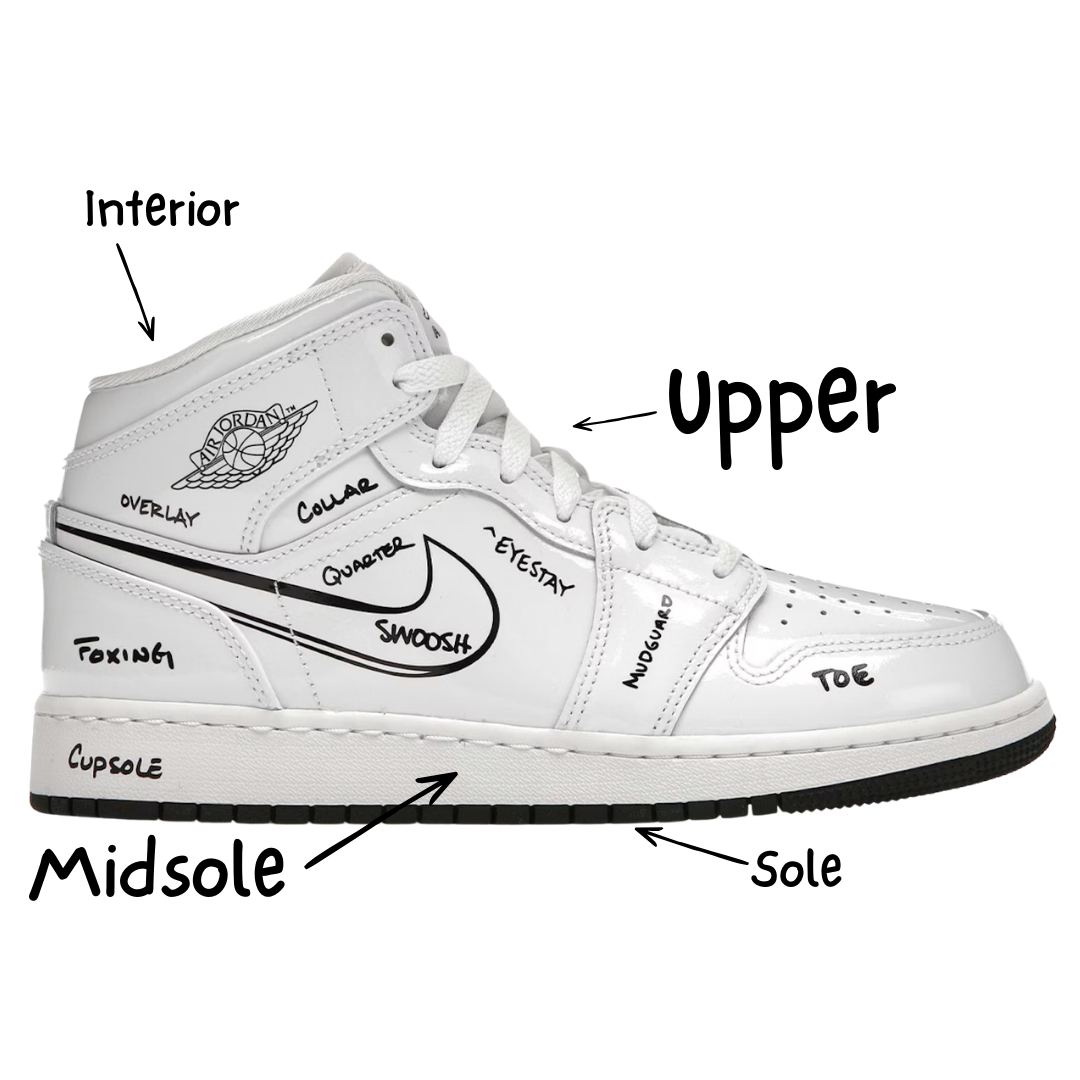
The upper is the largest scoring area - everything above the sole. The most common flaw? Glue stains. 99% of shoes have visible glue staining on the upper, and most people don't notice until you put the shoe under direct light.
The midsole sits between the upper and outsole - on Jordans, this is the visible foam or Air unit. Glue stains between midsole components are just as common as on the upper. Compression, scuffs, and discoloration from aging round out the typical issues.
The interior covers the insole, lining, size tag, and internal heel. Lint accumulation and pilling are the most common flaws here. The interior is the area people forget to check - and the area that's hardest to fake.
The sole (outsole) is the most honest part of the shoe. The factory sheen disappears after a single wear, dirt embeds in the tread pattern, and worn tread doesn't lie.
The Shoemetrics Grading Scale
Every Shoemetrics grade falls on a 1–10 scale with half grades. The overall score is a weighted composite of all four component scores - not a simple average.
Reading Nike Tags
The size tag is a sneaker's birth certificate. We'll use Nike as the primary example - it's the most searched and most collected - but these principles apply across brands.
Adidas, New Balance, and other brands use different tag formats - guide coming soon.
Roughly 80% of the tags I evaluate come from China and Vietnam, with slightly more from Vietnam. The shift tells a story about tariffs and how they've reshaped the sneaker supply chain.
2006–2019 (Barcode Era)
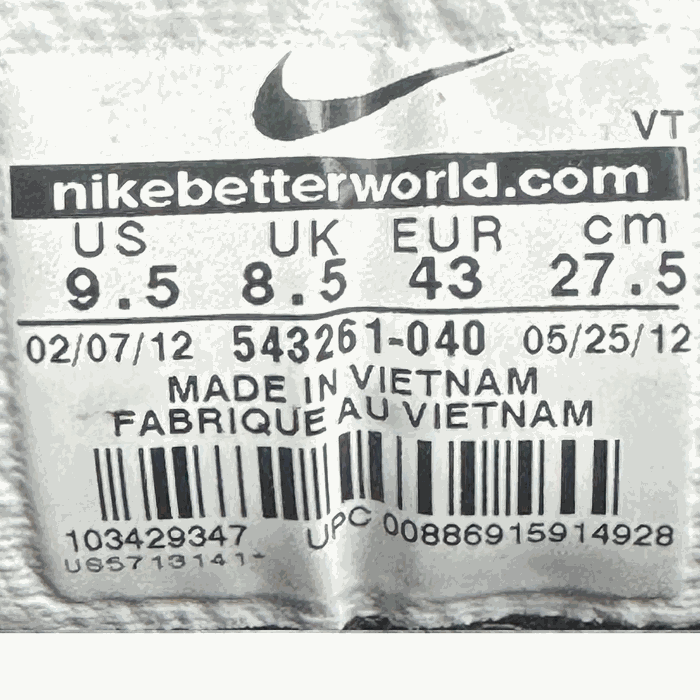
- Factory Code: VT (top right) - identifies the manufacturing facility
- Style Code: 543261 - the shoe model identifier
- Colorway: 040 - the color variant
- Production Dates: 02/07/12 | 05/25/12 - manufacturing and shipping dates
- UPC/Barcode: present in this era, removed in later tags
- Country: MADE IN VIETNAM
Updated font structure with UPC barcode present. Six-digit style codes became universal. Nike added nikebetterworld.com branding to tags during this period. This is the era where Nike's tag system stabilized into a predictable, verifiable format - making authentication through tag comparison significantly more reliable.
2019–Present (QR Code Era)
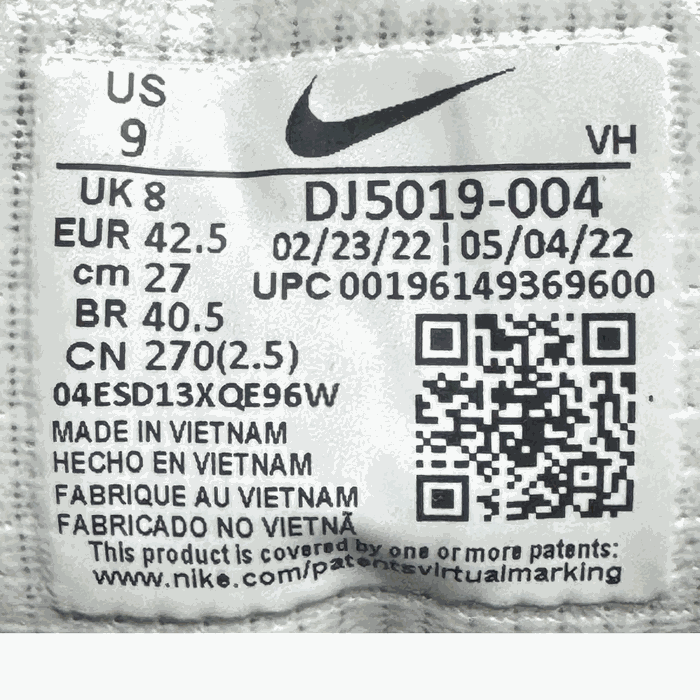
- Factory Code: VH (top right) - still in the same position across eras
- Style Code: DJ5019 - model identifier
- Colorway: 004 - color variant
- Production Dates: 02/23/22 | 05/04/22
- QR Code: replaced the barcode starting around 2019
- UPC: still printed as text, but barcode is gone
- Country: now shown in multiple languages
Major structural change: QR code replaced the barcode, country of manufacture now printed in multiple languages, sizing added BR/CN columns. The QR code links to Nike's product database - though counterfeiters have started replicating these as well. The factory code position (top right) hasn't moved, which makes it one of the most reliable reference points across eras.
Style Codes & Colorway Suffixes
Nike's style code system follows a consistent format: a base number identifies the silhouette, and a hyphenated suffix identifies the colorway. The suffix is often the fastest way to narrow down which version of a shoe you're looking at.
These are Nike/Jordan conventions. Adidas, New Balance, and other brands use different numbering systems - guide coming soon.
Nike's colorway suffix system is a general guideline - it doesn't work for everything, especially given that some silhouettes have several hundred colorways. But it was an early internal system for categorizing colors and it still holds for the most common codes.
-001 Black / Dark-002 Black / Alt-010 Grey-100 White-101 White / Black-102 White / Red-200 Tan / Brown-300 Green-400 Blue-500 Purple-600 Red / Varsity-601 Red / Black-700 Gold / Yellow-800 Orange-991 Nike By YouSample Codes & Special Tags
Samples are pre-production pairs made for internal use - sales meetings, wear testing, photo shoots, or player approval. They're among the rarest sneakers in existence and carry distinct markings.
The most valuable samples are unreleased pairs - shoes that never made it to retail. The least valuable are typically 999 samples (production test runs). Everything else depends on the specific shoe, silhouette, and story behind it.
Browse by Country
Vietnam
VHFinal Adoption GGPVFFinal Adoption GGP / PE SampleVWFinal Adoption GGPVTGGP Sample / Promo / Pro SampleVYSample Pro / Friends & FamilyCVGGP SamplePCPro Sample / Look See SampleVOCustomized AF1, Nike ID
China
XCSample GGP / Pro SampleXEPromo SampleXBF&F SampleSZGGP / Pro SampleLN2Promo SampleLN3EST / Promo SampleLN4Promo / Player Exclusive
Indonesia
JJSample GGPIASample GGPQMEHQ Sample / GGPIRFinal Adoption GGP / EMEAIWVintage Rare
Taiwan
FTAdoption GGP / Pro SampleYSFinal Adoption GGPPCGGP SamplePA3SampleFTSSSalesman Sample
Korea
DSSample GGP / GGP SampleT2Unreleased Sample
Brazil
BRRare Vintage
Full Reference - by Sample Type
Global Geo Pilot (GGP) Samples
| Factory Code | Country | Classification |
|---|---|---|
VH | Vietnam | Final Adoption GGP |
VF / VW | Vietnam | Final Adoption GGP |
FT | Taiwan | Adoption Sample GGP |
JJ | Indonesia | Sample GGP |
IA | Indonesia | Sample GGP |
QM | Indonesia | EHQ Sample / Global Geo Pilot |
YS | Taiwan | Final Adoption GGP |
XC | China | Sample GGP |
DS | Korea | Sample GGP / GGP Sample |
IR | Indonesia | Final Adoption GGP / EMEA Samples |
SZ | China | GGP / GGP Sample |
CV | Vietnam | GGP Sample |
PC | Taiwan | GGP Sample |
FT / LU | Taiwan / China | Final Adoption GGP |
VT | Vietnam | GGP Sample |
VF | Vietnam | Final Adoption GGP |
Pro Samples & Promo Samples
| Factory Code | Country | Classification |
|---|---|---|
VY | Vietnam | Sample Pro |
VT | Vietnam | Promo Sample / Pro Sample |
XE | China | Promo Sample |
SZ | China | Pro Sample |
XC | China | Pro Sample |
FT | Taiwan | Pro Sample |
PC | Taiwan / Vietnam | Pro Sample / Look See Sample |
LN2 | China | Promo Sample |
LN3 | China | EST Sample / Promo Sample |
LN4 | China | Promo Sample / Player Exclusive |
VF | Vietnam | PE Sample |
Special & Rare
| Factory Code | Country | Classification |
|---|---|---|
VY | Vietnam | Friends & Family Edition |
XB | China | F&F Sample |
FTSS | Taiwan | Salesman Sample |
T2 | Korea | Unreleased Sample |
VO | Vietnam | Customized AF1, Nike ID |
BR | Brazil | Rare Vintage |
IW | Indonesia | Vintage Rare |
| (none) | Various | Often vintage, unreleased, or special production runs - no factory code appears frequently across Indonesia, Vietnam, Taiwan, Thailand, China, and Korea |
Sample code data compiled with thanks to @donniebsoles, who originally published this research on Instagram. Used with permission.
Production Eras
How a sneaker was made - and when - directly affects what condition issues to expect. Materials, adhesives, and construction methods have changed dramatically over four decades.
-
1985–1995
OG Era
Most basketball shoes are leather or nubuck with polyurethane soles. Runners use more mesh with EVA and polyurethane. Polyurethane doesn't age well - most shoes from this era, except OG Jordan 1s (which have rubber soles), have fallen apart, are unwearable, or are actively crumbling. Rubber and vulcanized soles are the survivors. Unless it's a rubber-soled shoe, expect structural issues. These are display pieces, not wearable sneakers.
-
1996–2005
Retro Boom
Similar sole compounds to the OG era for the most collectible shoes. The most collectible pairs - Jordans, Air Maxes - have likely crumbled or are in pieces due to their sole compositions. Dunks, because of their rubber soles, are still going strong. Shape and sizing is off on aged pairs, glue is likely yellowed or separating. Dunks from this era can still be great. Jordans and Air Maxes are gambles - inspect the soles carefully.
-
2006–2015
Modern Retro
More Phylon (compression-molded EVA) which lasts significantly longer than polyurethane. A lot of these shoes are still presentable - probably not the most comfortable for daily wear, but they've largely held up structurally. Expect yellow glue stains and likely some glue separation. Wearable but showing age. Good value for collectors who want shoes they can actually put on.
-
2016–Present
Current Era
The invention of performance foams - Boost (Adidas), React (Nike), and others. These yellow but hold up well structurally over time. Most shoes from this era are in solid shape. Foam yellowing is the main cosmetic issue. The safest era to buy pre-owned - materials are more durable and age more gracefully.
Midsole Materials: Why It Matters
The midsole is usually the first component to break down. It comes down to what the midsole is made of. There are 5 major types commonly used in sneakers, each with different characteristics around cushioning, durability, weight, and cost.
Polyurethane (PU)
High RiskJordan 2–6, 8–18, Air Max 1/90/95/97, Plus, Air Tech Challenge, 80s/90s Nike basketball
Great for cushioning and support. Easily molds into complex shapes - ideal for embedding visible Air units into soles.
Can crumble if not worn or stored properly. The number one killer of vintage sneakers.
Ethylene-Vinyl Acetate (EVA)
ModerateEarly runners (Waffles, Cortez, NB 574s), older trainers
Lightweight and flexible. Cheap and easy to produce. Compresses for softer landings.
Wears out faster with frequent use. Compresses over time and loses its bounce.
Phylon
GoodMany modern Nike running and basketball shoes (early LeBrons). Compressed, heat-expanded EVA foam.
Lightweight like EVA but more responsive. Good balance of cushion vs weight. Often used as carrier foam around Zoom Air units.
Compresses over time. Can feel too soft or unstable for some wearers.
Foam Composites (Boost, React, ZoomX, Fresh Foam)
GoodNike React, ZoomX, Adidas Boost, New Balance Fresh Foam
Very lightweight, high energy return, comfortable for long wear.
Can be unstable. Expensive. Some foams discolor or oxidize over time.
Rubber
BestJordan 1s, Dunks, Vans, Chuck Taylors, Adidas Sambas
Extremely durable. Simple and low-cost. Stable on flat surfaces. Lasts decades.
Heavy. Minimal cushioning. No energy return. Not suitable for impact sports.
Comparison
| Material | Comfort | Durability | Flexibility |
|---|---|---|---|
PU | High cushioning | Prone to crumbling/yellowing over time | Moldable, but heavier and less flexible than newer foams |
EVA | Lightweight comfort | Compresses over time, loses bounce | Very adaptable, easy to shape for multiple designs |
Phylon | Slightly firmer than EVA | More durable than regular EVA | Still very flexible, used in sleek midsoles |
Foam | High energy return | Yellows but holds up structurally | Easy to mold, used across performance and lifestyle |
Rubber | Firm, less impact absorption | Extremely long-lasting | Difficult to sculpt, adds weight |
How Sneakers Age
Even unworn sneakers degrade over time. Understanding aging is essential for grading vintage and deadstock pairs accurately.
Yellowing & Oxidation
Most yellowing happens with shoes that aren't worn. Glues solidify and clear panels - like visible Air units - start to deteriorate. The biggest enemy of sneakers is actually never wearing them. Glue typically turns yellow after several years of sitting. Storage in direct sunlight accelerates yellowing dramatically.
Midsole Crumbling
Jordan 1s are great - rubber soles that last. Jordans 2 through 9 all have crumbling issues due to polyurethane. Almost all vintage Air Maxes have similar problems. Dunks last. When crumbling starts depends entirely on storage environment and whether the shoes were ever worn.
Glue Separation
Anything too dry will cause glue separation over time. The fix is, seriously, wearing them a couple of times a year. Using the shoe gives the glue its tensile strength. Shoes that sit in a box for a decade without being worn will separate.
Material Degradation
Rubber holds up best over decades. Polyurethane is the worst - it literally disintegrates. Leather ages well if stored properly. Mesh and synthetics hold up but can yellow and become brittle.
Common Misconceptions
"Deadstock means perfect."
MythDeadstock means never worn - that's it. Plenty of unworn shoes are far from perfect. Yellowed glue stains, oxidation, crumbling, poor storage - a deadstock shoe that sat in a garage for 15 years can grade lower than a pair that was worn carefully a dozen times.
"Worn once means near-new."
MythMost "worn once" pairs weren't actually worn once, or they were worn once in conditions that weren't kind to the shoe. One wear through rain or on rough pavement can do more damage than twenty wears on clean indoor surfaces.
"Yellowing means the shoe is fake."
MythNo. Yellowing is chemistry - oxidation of materials and adhesives over time. Every shoe yellows eventually. It's a sign of age, not a sign of counterfeiting.
"Creases mean the shoe is beat."
MythA hallmark of quality leather is how soft it is. Natural creasing on premium leather can actually make a shoe look better - it develops character. But lower quality leather - the hard stuff I call "plastic leather" - makes creasing look terrible. The material determines whether creases are a flaw or a feature.
"If a shoe looks too perfect, it must be real."
MythBecause fakes are sometimes made under less rigorous conditions with tighter quality control for smaller batches, some counterfeits actually grade higher than their authentic counterparts. A perfect example: the Jordan IV "Travis Scott" and the Jordan 13 "Melo" - both notorious for blatant glue staining where the midsole meets the light-colored nubuck or suede upper. The stains really stand out. Almost any time I see a pair of either shoe without glue stains, I operate from the assumption that it's fake. Perfection can be a red flag.
Spotting Fakes
After evaluating 100,000+ pairs, pattern recognition becomes instinct. But here are the universal red flags that apply regardless of model.
Most Commonly Faked Models
Look at StockX's top 25 sellers on any given day - the top 5 most faked models will be somewhere on that list. Counterfeiters follow the money. Whatever is selling for the highest premium is what's being replicated.
Universal Red Flags
Size tag. 100%. The tag is the first thing I check on every single pair. Typography, kerning, layout, print quality - the tag tells you more than almost any other part of the shoe.
- Tag typography - font weight, character spacing (kerning), print quality
- Stitching inconsistencies - uneven spacing, loose threads, wrong color
- Material feel - wrong weight, texture, or finish compared to authenticated pairs
- Box label mismatches - style code on box doesn't match tag inside shoe
- Glue issues - excessive visible glue, wrong color adhesive
What Photos Can't Tell You
Weight and the feel of the material. You can study stitching and tags all day in photos, but you can't feel the difference between real and fake leather, or notice that a shoe is 20 grams lighter than it should be. That's why in-hand evaluation exists.
Want your pair professionally evaluated?
Get Started