
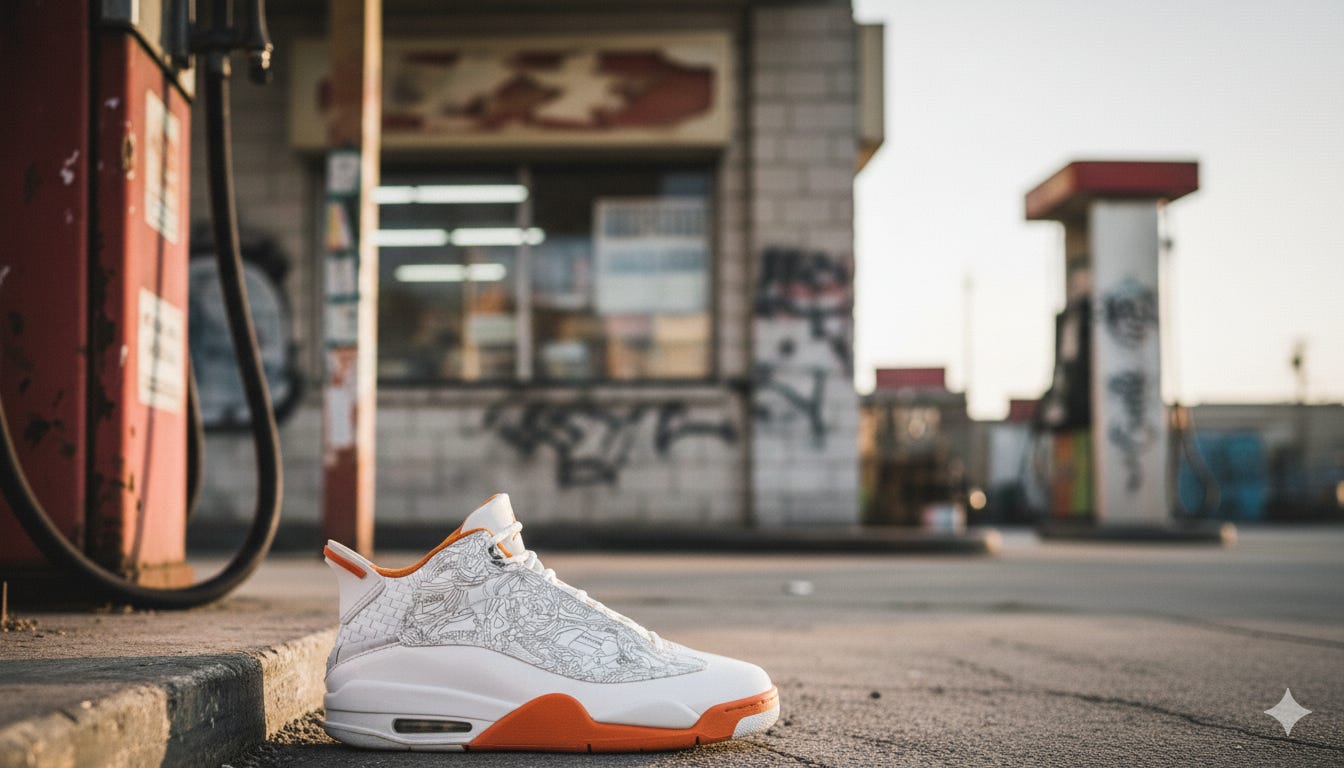
A few months ago, I posted a meme that I didn’t expect to turn into what it did: the ‘Jordan Brand buyers guide’ Venn Diagram. Three circles - “Regular Joes,” “Sneakerheads,” and “Hypebeasts.” In the overlap between Regular Joes and Sneakerheads, I put one word: 6 Rings.
A lot of comments on the post focused on that shoe alone - so much - in fact, that I felt compelled to make a follow-up post - ‘Jordan Brand buyers guide (6 rings addendum) to explain the point I was trying to make.
The original point was simple: sneakerheads - the kind who approach this stuff from history and lived experience rather than resale or status - generally know, have owned, and often still have a bit of respect for the original Jordan hybrid. And at the same time, non-sneakerheads see something familiar and legible in those same shoes. That overlap matters.The follow-up post went a bit deeper - I made the bold claim that regardless of how you classify yourself, if you’re following me on IG, you’ve likely owned a pair of 6 rings.
Hypebeasts and newer collectors dragged that idea through the mud. And…yeah…that’s fine. But if you’ve been in this space long enough, pattern recognition is far more interesting to me than a hot take. The Jordan hybrid wasn’t always “basic.” At one point, it was one of the most interesting ideas Jordan Brand had. And revisionist history isn’t something I dabble in.
At its core, a hybrid is exactly what it sounds like: elements pulled from existing models and combined into something new. Sometimes there’s a story, sometimes there isn’t. The Jordan 6 Rings is the most obvious example - a single sneaker built from the six sneakers Jordan wore during his six championship runs:
Jordan 6: heel tab, lace locks
Jordan 7: sockliner and perforations
Jordan 8: strap and fuzzy tongue logo
Jordan 11: patent leather and silhouette
Jordan 12: metal lace loops and “TWO3”
Jordan 13: shape and outsole pods
Jordan 14: Jumpman toe hit
Other hybrids followed similar logic: the Spi’Zike, the 60 Plus, the MVP. Then came hybrids without narrative - Jordunks, Air Force Fusions, CMFRT Air Max Jordans - until the whole category blurred together, especially if you stopped paying attention after the third or fourth iteration.
What’s funny is that despite living in what I’d call a sneakerhead bubble, I think I see more hybrids in real life than flagship retros. Airports. Malls. Schools. Gyms. I couldn’t name half of them, but I recognize the big three immediately: 6 Rings, Spi’Zikes, Dub Zeroes. Not coincidentally, those were the first.
And yet, modern sneaker culture seems to have decided hybrids are unforgivable.
I once watched a kid in my 10th-grade geometry class - wearing Jordan XI’s - try to fight another kid wearing Jordan Futures (XI hybrids). Not over words. Not over basketball. Just shoes. That moment stuck with me. It was absurd, but it revealed something real: hybrids violate some kind of unspoken hierarchy.
Despite all that noise, Nike keeps releasing them. Over and over. New colorways, new materials, old models, slight tweaks. And people keep buying them. Which raises the real question: why?
Ask any sneakerhead to break down a hybrid and they probably can. Pull this from a 6, that from an 11, something else from a 13. It can be fun. It’s trivia disguised as design. Most people don’t know every reference, and they don’t need to. The shoe carries the (historical) load. Do I remember all 6 flagships that MJ wore during his championship run? I don’t need to. I just look at the 6 Rings.
Basketball aside - Michael Jordan was the right dude at the right time. From McDonalds to Gatorade to Hanes to Upper Deck to Chevy to Nike - he is the epitome of American popular culture. Ask any American kid who MJ was and you’ll get some version of “basketball,” “black and red,” “shoes.” That’s enough. And hybrids operate in a similar way. They compress decades of history into a single, legible object.
Sneakerheads tend to judge hybrids like artifacts. Nike sells them like products. The general public accepts them as both. And that tension - not the shoe itself - is what people are actually reacting to.
The first hybrid I wanted to own was the first release of the Spi’Zike - the ‘Kings County’ colorway. This was because I was living in Kings County (Brooklyn) at the time and I was keen on anything Spike Lee adjacent. The first hybrid I owned, though, was the Bred 6 Rings. And to be even more blasphemous - I found them to be more wearable than the shoe they most resembled (the Black/Red XI). I eventually traded that pair to a non-sneakerhead friend for some sunglasses and a winter coat, and he was ecstatic. In my opinion, he felt I was ‘letting him in to sneaker culture’ by giving him that pair. He was stoked, and I felt like I did him a service.
I finally found a pair of the Spi’Zikes at an outlet, wore them a bit, but overall I never really felt right in them. Like why should I wear these when I have the originals? Why would I wear a refined version of something that doesn’t need a revision to begin with? Why would I wear a celebration of something when I can wear the thing itself? And that’s when I realized that that’s where sneakerhead culture tends to live: on the edges of the mainstream narrative.
That being said, I like seeing non-sneakerheads in hybrids. I LIKE seeing folks that don’t live this or breathe this TRYING to locate that common ground. In the purchase of a hybrid, they are attempting to participate in this culture, and I think it’s silly that folks decide to shun them. Every month or so, the major blogs post a meme that can ultimately boil down to the fact that they don’t respect hybrids or the people that buy them.
I get it, sometimes gatekeeping feels like love. But more often than not, I see hybrids as an on-ramp to the culture, not the bastardization of it. Nothing pleases me more than watching a non-sneakerhead light up when I can break down sneaker culture through their hybrid; “…Yeah, and you see this little Jumpman there on the toe? This is pulled from the shoe that Michael Jordan wore in ‘The Last Shot.’”
Putting ‘6 Rings’ in that little Venn Diagram opened up my eyes to the fact that father time is coming. There are young sneakerheads entering the sphere that missed that whole ‘hybrid’ boat, and have no idea the historical context from which I was pulling. But that’s also kind of the thing…the ‘sneakerhead’ in me has never been much about fitting in or buying the things that others find interesting…the sneakerhead in me has always been about feeling good about myself. And if someone feels fresh or dope rockin hybrids - who am I to tell them any different? We’re still paying homage in our own way. Getting older has made me realize that the long way around isn’t about proving how much you know - it’s about knowing enough to let others in.
The long way around.