
In 2019, a man I didn’t know reached out to me from overseas and asked if I could authenticate a pair of shoes he had just bought. His English was limited. The message was short. Polite.
At first glance, I assumed I knew exactly what this was.
At the time, replica manufacturers were getting smarter. Some were sending out feelers. Testing the edges of authentication. Seeing what could slip through. The shoes he sent me pictures of were very rare and very expensive. The kind of pair that doesn’t usually land in the hands of someone asking questions after the fact.
I was wrong.
Or at least, there was evidence of truth that I wasn’t expecting.
He sent documentation. A StockX receipt. Emails. Dates. Numbers. Everything lined up. Even the import fees checked out. And thanks to a data breach a few months earlier, I could verify that the email address existed in StockX’s system. Someone really had paid over twenty thousand dollars for this particular pair - and the email addresses matched. Wow.
Hmm.
Maybe there was something to this. Not because the shoes were suddenly real. But because the assumptions I brought with me were suddenly irrelevant.
I don’t know if what I had in front of me was a fake manufacturer testing the system, or if it was an actual customer who spent a great deal of money on a rare collectible. But, given the evidence, it seemed like it was a customer caught between belief and doubt, holding an object whose value depended entirely on whether enough strangers agreed on it’s authenticity.
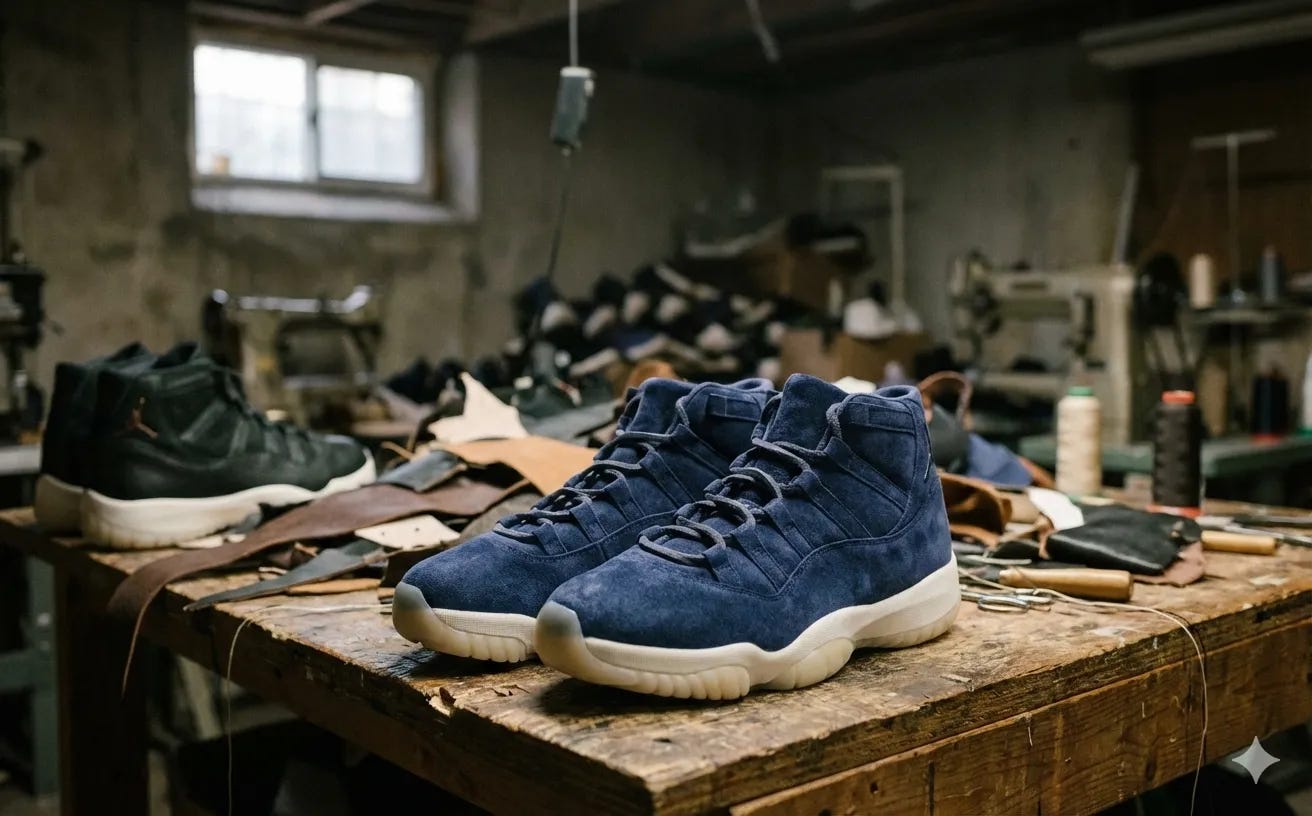
The shoes were Derek Jeter Air Jordan 11 highs. A sample run. Mythologized. Every major sneaker outlet repeated the same line: five pairs released. Scratch-off lottery. Bronx pop-up. End of story.
Except stories like that are never the end.
Because the deeper I looked, the less stable that number became. I could easily account for more than five pairs. Some in shops. Some cross-listed. One in Chris Paul’s closet. One in my customer’s hands. One on the shelves behind PJ Tucker. Another owned by a friend. Either several were fake, or the story everyone kept repeating was a lie.
That happens a lot with sneakers. Numbers become facts because they’re easy to remember, not because they’re true.
I started reaching out. Shops didn’t respond. Sellers disappeared. Platforms wouldn’t provide images. Everyone had a stake, and no one wanted to be the one to say something definitive. But they definitely wanted their commission.
Eventually, I found one of the actual scratch-off winners. And…what are the chances…she lived in my city - Oakland, California. She wasn’t a sneakerhead - just a lucky tourist that happened to be in the Bronx at the time the scratch-off contest commenced. She had won the shoes, consigned them, and moved on. She had photos. Emails. Documentation. A handwritten letter from Jordan Brand. She had the kind of proof only a real winner would have. She was bonafide.
But even then, it wasn’t a closed case. Because she consigned them at a popular shop that wasn’t exactly known for being helpful. Evidence it came slowly.
In my process - evidence comes in millimeters, spacing, kerning and fonts. And in stitching and in details so small they felt absurd compared to the amount of money involved.
The differences weren’t dramatic. No cartoon flaws. No obvious shortcuts. Just tiny deviations. The kind you only notice after hours of looking. The kind that don’t matter if you’re wearing the shoe, but matter deeply if you’re trying to decide what reality is supposed to be. I had the help of a couple of well-known and well-respected sneakerheads in the space.
And eventually, we landed on an answer. Not a satisfying one. Just the most honest one we could reach. I found something blatantly obvious that the others overlooked, but IMO, it was the smoking gun.
Once the information was presented to them - we all agreed - we believed the pair was fake.
The buyer didn’t agree with me.
And when I posted the full story on Instagram, people reacted the way people always do when certainty is threatened. Some thanked me. Others accused me of not knowing what I was talking about. A few treated it like a courtroom drama, as if the goal was to win rather than understand.
Everyone and their mother seemed to have an opinion but no one brought receipts. Some folks claimed there were 40+ pairs in existence, others claimed the published ‘5’ was the real number. Some people called me an idiot, others said I was brilliant. Again, no one brought receipts.
Later, someone at Jordan Brand saw the evidence. Then the actual designer of the shoe did too. Both agreed with the assessment. And that should have been the end.
But it wasn’t. Because I continued to receive ‘expert assessments’ for several years after the fact.
What stuck with me wasn’t the vindication from the people that were actually in the room. It was the realization that the entire exercise had less to do with shoes than we’d like to believe.
These objects we covet so dearly and occupy our time with sit in a strange space. They’re treated like enviable artifacts but made like commodities. We ask them to carry meaning, history, and value far beyond what they were designed to hold. And then we’re surprised if and when they crack under the pressure.
Since then, I’ve authenticated more than 100,000 pairs of shoes. And I’m better now than I was then. But if that same pair crossed my desk today, I probably approach it the same way: Cynically, then carefully, then skeptically. And willing to say “I don’t know” longer than people are comfortable with.
Because some shoes don’t want to be known with certainty.
And maybe that’s the point.
The line between sneakers as collectibles and sneakers as tools is thinner than we like to admit. One day you’re preserving history. The next you’re just trying to decide what’s worth wearing. I move back and forth across that line all the time.
The longer I do this, the less interested I am in being right, and the more interested I am in being thorough.
And that kinda feels like the long way around.